Gratitude and Commitment: A Message from Commit to Keiki
As we enter this season of gratitude, Commit to Keiki gives thanks for the many partners, advocates, elected officials and our Commit to Keiki steering committee members who continue to prioritize the well-being of Hawai‘i’s youngest keiki and families. Every act of service, every policy advanced, and every moment of care shared in homes, classrooms, and programs strengthens the foundation of our state.
This year has reminded us how important that foundation is. Families across Hawai‘i’s are feeling the weight of rising costs and uncertainty about the future. Federal changes have created new challenges for programs that provide critical supports such as child care, nutrition assistance, and early intervention services. Yet through it all, Hawai‘i’s early childhood community continues to show extraordinary resilience, innovation, and heart.
Our shared work has never been more important. When we invest in our youngest keiki, we invest in Hawai‘i’s future, one where families are stable, communities are strong, and every child has the opportunity to reach their full potential. Mahalo for being part of this shared commitment. Together, we can continue to protect what matters most and ensure that every keiki in Hawai‘i grows up safe, healthy, and supported.

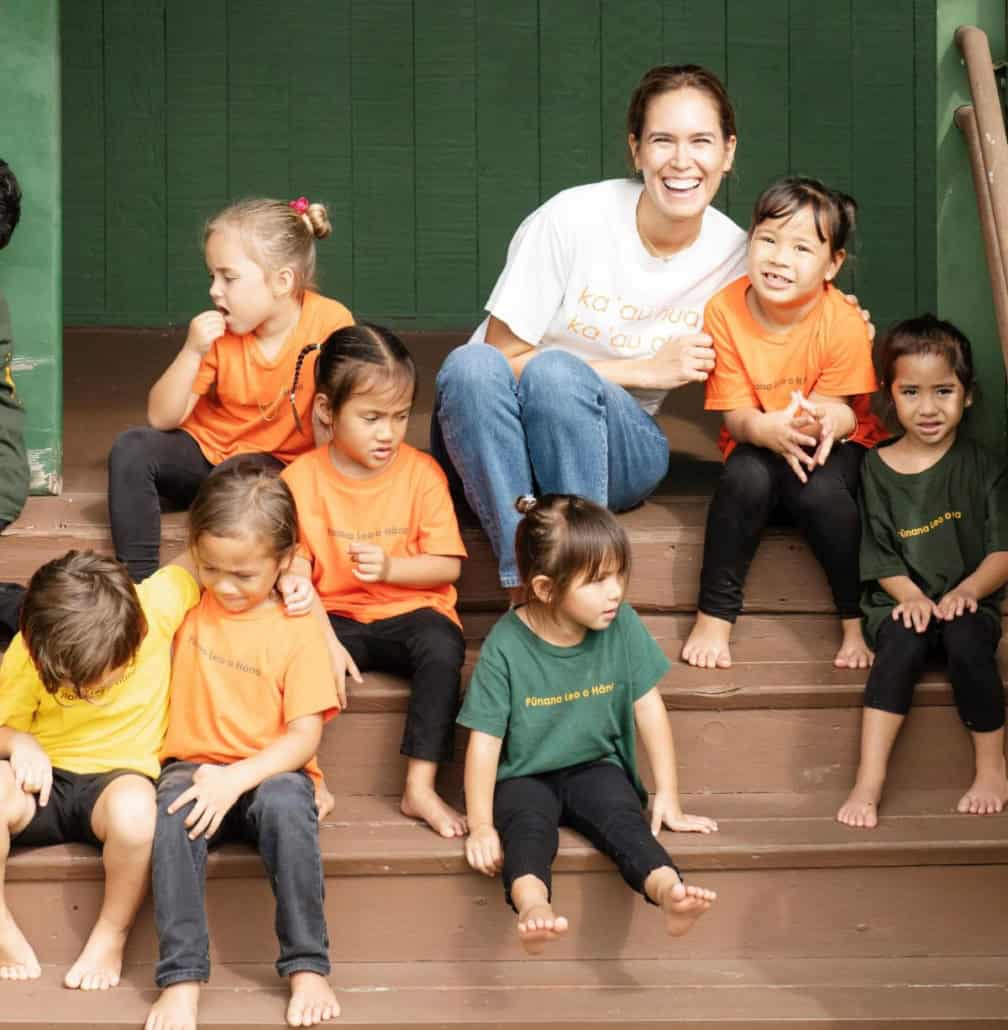
Kaʻiulani Neff Laehā
CEO
ʻAha Pūnana Leo
Behind every effort to support Hawai‘i’s keiki are champions leading the way. In this new series, we’re spotlighting one leader whose work is helping to strengthen the systems that care for our youngest keiki and their families. This month, we are honored to feature Kaʻiulani Laehā, CEO of ʻAha Pūnana Leo, and member of Commit to Keiki’s Steering Committee.
Q: What personal or professional experiences have most shaped your commitment to supporting young children and families in Hawai‘i?
A: I was born and raised here in Hawaiʻi (and am committed to staying here), and now, as a parent with two keiki, this kuleana feels personal in every way. I’ve spent my career working with communities that have sometimes been left out or underserved, so I’ve seen firsthand what happens when families are lifted up, supported, and truly valued. When our families have what they need, whether it’s access to quality care, culture, or just the basics of safety and belonging, our keiki grow up with confidence and hope. It’s obvious to most of us in Hawaiʻi that ʻohana is at the heart of everything, but too often, our systems and policies don’t match that value. That’s the shift I’m working for, to align our actions as a community with the values we all say are important.
Q: From your perspective, what does a strong, resilient early childhood system look like? What’s at stake if we fail to strengthen it?
A: A strong system, to me, is where every family knows they’re backed up by their community; where no child falls through the cracks, and where safety, care, and culture aren’t privileges, but expectations. It’s more than just funding or programs; it’s a shared understanding that all of us are responsible for raising our keiki. If we don’t get this right, the consequences are real. We risk losing generations of potential, repeating cycles of struggle, and not living up to the values we talk about as Hawaiʻi. Getting it right means a future where keiki are confident, connected, and ready to give back when itʻs their turn.
Q: Is there a project, program, or initiative you’ve been involved in —in the past — that you feel represents meaningful progress for young keiki and families? What was its focus, and what impact did it have?
A: Through ʻAha Pūnana Leo, I’ve seen families transform through Hawaiian language revitalization, often times multiple generations learning together. I’ve watched friendships and bonds form that last a lifetime, all rooted in culture and place. Those moments when you see a keiki and their parents light up as they reclaim their sense of being Hawaiian, or when families build real relationships around shared Hawaiian values, that’s what meaningful progress looks like to me. It’s definitely about the language, but it’s also about giving kids a stronger sense of who they are, which ripples out into everything they do.
Q: Is there a project, program, or initiative you’re currently supporting that you would like to highlight?
A: We’re still working hard at ʻAha Pūnana Leo to support our staff and teachers, because when they feel valued and empowered, our keiki benefit. It’s about creating spaces where kids are safe, loved, and connected to their identity and supporting the adults who make that possible. The outcome I care most about is seeing strong, healthy ʻohana and passionate, prepared staff, because they’re the foundation of everything we do.
Q: Where do you see the greatest opportunity to strengthen systems that serve Hawai‘i’s youngest keiki and their caregivers?
A: The current child care business model just doesn’t add up. Families are asked to pay more than they can afford, but even that tuition rarely reaches the level needed to properly pay and support staff. Meanwhile, every keiki deserves access to quality care, no matter their family’s income. What we really need is a system where providers aren’t expected to cut corners, families aren’t stretched to the limit, and our caregivers are recognized as vital professionals.
It’s also essential that we continue to nurture private and community-based child care options. Programs like ʻAha Pūnana Leo and other private, non-profit centers offer niche, culturally-rooted, and innovative care that large systems simply can’t replace. Families should have real choices and opportunities to find the kind of environment, values, and teaching that fit their needs. Preserving and investing in these private child care options keeps our system diverse, responsive, and strong. If we can shift our public investments to back up these values, we’re not only making early care accessible but also protecting the quality and uniqueness that makes Hawaiʻi so special for our keiki and their ʻohana. Bottom line, caring for our keiki to the best of our ability should be at the top of our priorities.
When Federal Shifts Hit Home: Why Hawai‘i Must Keep Investing in Keiki

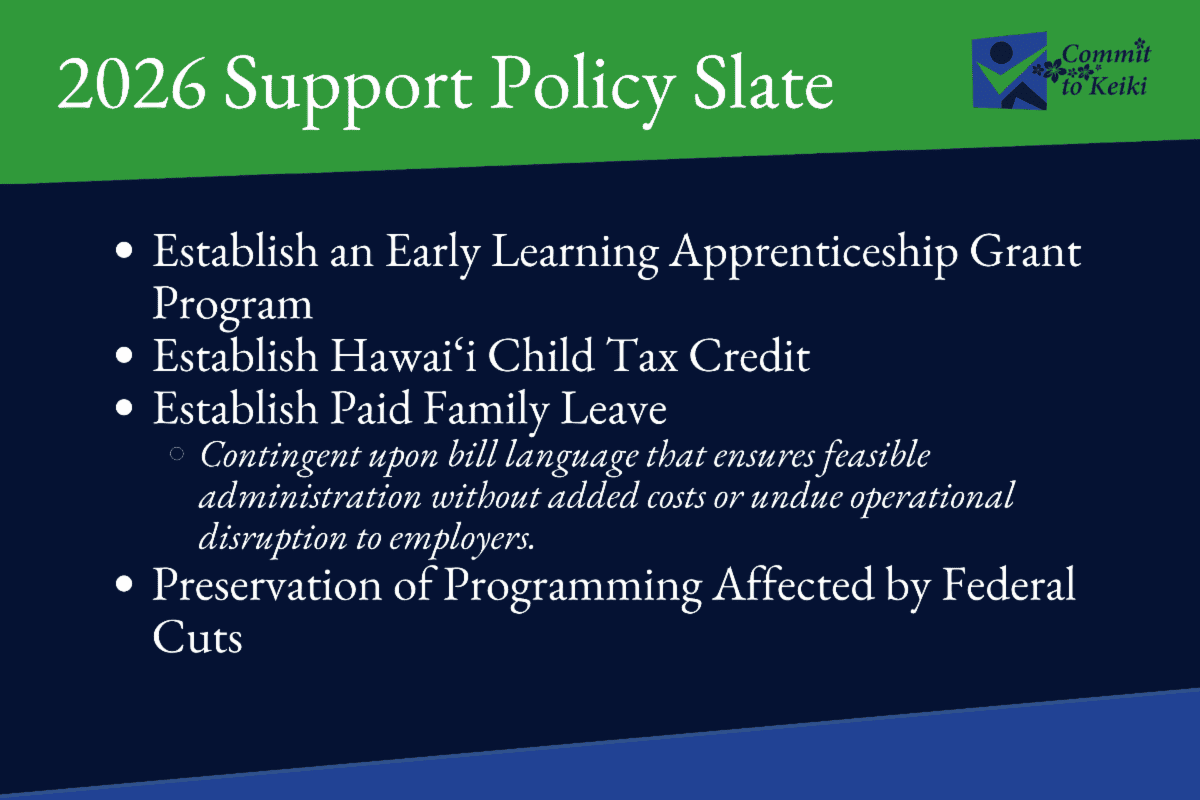
Across the country, the systems that support young children and their families are under significant strain. The federal government shutdown has halted or delayed critical funding for essential support services, creating widespread uncertainty. At the same time, disruptions to key safety net programs, including nutrition assistance, have left families worried about how they will meet their most basic needs.
In Hawai‘i, where the cost of living is already among the highest in the nation, the effects are even more pronounced. When paychecks stop or benefits are delayed, parents are forced to make difficult choices about food, housing, and childcare.
Local nonprofits and service providers are doing their best to fill the gaps, but they too are managing workforce shortages, limited resources, and growing demand for assistance. Early learning centers, family resource organizations, and community programs are reporting higher calls for help at the very time their own funding is uncertain. The strain continues to build across the systems that keep Hawai‘i’s keiki and families safe, healthy, and supported.
At Commit to Keiki, we remain focused on achieving long-term stability for our community’s youngest keiki and their ‘ohana by advocating for investments that will preserve critical programs, strengthen our early childhood workforce, and keep local families supported.
“Our goal is to put in place publicly-funded guardrails that protect existing programs while also creating and strengthening new ones that meet the evolving needs of Hawai‘i’s youngest keiki and their families.”
-Kerrie Urosevich, executive director of the Early Childhood Action Strategy and co-chair of the Commit to Keiki Steering Committee.
Investing in early childhood development is not simply a matter of compassion, it is one of long-term stability. The first five years of life set the course for everything that follows: school readiness, workforce participation, economic strength, and community well-being. Strengthening these systems today will protect generations to come.

Hawaii News Now, Oct. 20, 2025
Hawaii celebrates opening of state’s 100th public pre-K classroom
Kauai Now, Oct 30, 2025
Child & Family Service celebrates grand opening of first Infant and Toddler Center
Honolulu Star-Advertiser, Sept. 19, 2025
Child poverty in Hawaii rises and may get worse, report says
Hawaii Public Radio, Nov. 6, 2025
How one parent is navigating her local Head Start closure during the government shutdown
Supporting Keiki Mental Health This Holiday Season

The holiday season brings both joy and challenge. Families gather, calendars fill, and expectations rise. For parents and caregivers, this time of year can feel overwhelming as financial pressures, disrupted routines, and emotional demands build. For young keiki, who depend on consistency and emotional connection, the effects of family stress can be significant.
A child’s earliest relationships shape how their brain develops, how they manage emotions, and how they connect with others throughout life. Stress in a child’s environment, especially when persistent, can affect brain development and influence everything from learning to long-term health. The good news is that relationships are also the antidote. Even in stressful seasons, simple moments of connection such as reading together before bed, cooking a meal as a family, or taking a quiet walk can help children feel secure. When caregivers stay emotionally present, it teaches keiki that even during change or chaos, they are safe and loved.
Here are a few ways families can support emotional well-being this season:
- Keep familiar rhythms. Predictable routines such as mealtimes and bedtime give children a sense of stability.
- Choose connection over perfection. Focus on shared moments, not flawless celebrations.
- Model calm. When parents take a breath or ask for help, keiki learn that it is okay to do the same.
- Ask for support. Community organizations and family resource centers can offer guidance or relief for families feeling stretched thin.
As we enter into the busy holiday season, Commit to Keiki encourages families to embrace the small, meaningful moments that nurture connection. These are the moments that build lifelong resilience and remind us that the best gift we can give our keiki is our time, presence, and love.

DID YOU KNOW?
78% of O‘ahu voters and 80% of Hawai‘i Island voters say they are more likely to support candidates who prioritize publicly funded child care, early learning, and family support services.
When families can access affordable, quality care, parents can work, keiki can thrive, and our economy grows stronger. And when ‘ohana have the family supports they need, keiki grow up healthy, happy, and ready to succeed.
Click here to read Commit to Keiki’s 2024 polling results. New statewide polling will take place in 2026.