July 14, 2025
On July 4, the federal budget reconciliation bill was signed into law after clearing both the U.S. House and Senate. While this marks the end of a legislative process, it is only the beginning of understanding what these sweeping changes will truly mean for Hawai‘i’s youngest keiki and their families.
At Commit to Keiki, we are carefully reviewing the legislation, working to understand how it will impact early childhood programs and services across our state. While many details are still unfolding, we do know the law includes significant funding reductions and policy changes that will directly affect young keiki and families, especially those who are low-income or who rely on Medicaid, SNAP, or community health centers for essential care and support.
Key takeaways so far:
-
- IDEA funding preserved: The bill does not directly cut federal funding for the Individuals with Disabilities Education Act (IDEA), which includes Part B services that support children ages 3-21 in public schools and Part C services that provide early intervention for infants and toddlers with developmental delays. This means these core education and early intervention programs remain intact for now.
- Child care programs untouched: Funding for the Child Care Development Block Grant, which helps subsidize child care costs for low-income families, and Head Start also remains unchanged. This offers some reassurance that these critical early learning supports will continue.
- Cuts to Medicaid and SNAP: The law does reduce funding for Medicaid and SNAP, which are vital programs for many Hawai‘i families. In rural counties such as Hawai‘i, Kaua‘i, and Maui, about half of our keiki rely on Medicaid (QUEST) for health care coverage, including mental health screenings and therapies, speech and physical therapy, and access to providers through federally qualified health centers. These cuts could limit essential care and place added strain on already stretched services.
- Reduced reproductive health funding: The bill also cuts funding for reproductive health, which may affect prenatal care and pregnancy prevention efforts. This is especially concerning in rural communities where families often rely on local health centers for comprehensive care.
- Child tax credit changes: While the legislation increases the child tax credit, early analysis suggests new restrictions could prevent many families who need the support most from accessing these benefits.
The Infant & Toddler Coordinators Association (ITCA) also notes concerns about long-term stability for federal programs serving infants and toddlers, and flags the risk of new administrative requirements that could complicate how services are delivered.
Commit to Keiki is approaching this with care and a strong sense of responsibility. We will continue to monitor these developments closely and share updates as more information becomes available. Mahalo for standing with us and for your continued support of Hawai‘i’s youngest keiki and their families.
June 18, 2025
On May 30, the Office of Management and Budget released over 1,224 pages of the President’s updated budget proposal for Federal Fiscal Year (FFY) 2026. As Congress and the President work toward a funding agreement by the September 30 deadline, this proposal offers an early look at where federal priorities may be headed and what that could mean for Hawai‘i’s youngest keiki and their families.
While the proposal includes a 13% increase for Homeland Security and the Pentagon, it also outlines sweeping cuts across social services, public health, education, and research. These reductions will disproportionately impact women and children, including young keiki and the families and providers who support them. This raises important considerations about the balance of our federal priorities, particularly when the wellbeing of our children is at stake.
Here are a few key takeaways from the proposed FFY 2026 budget:
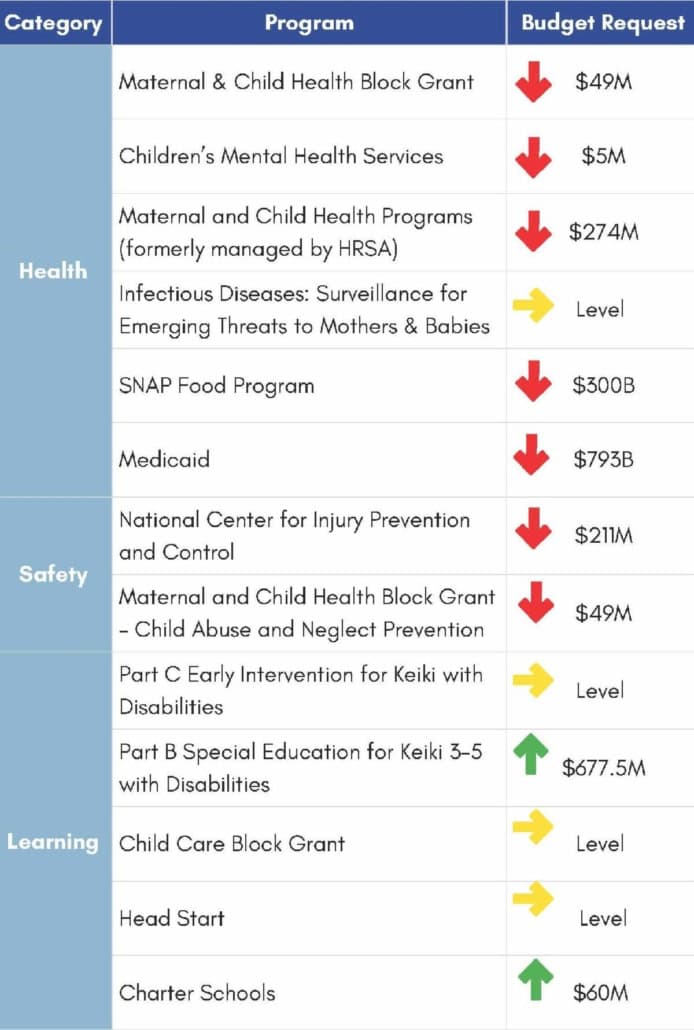
- Early Childhood Mental Health: Federal funding for early childhood mental health will be almost entirely eliminated. There appears to be a general gutting of public health infrastructure across the board, including cuts to reproductive health services that support maternal wellbeing and family stability.
- Family Violence Prevention: Family violence as it relates to gender-based and child violence is being targeted. However, funding remains for some suicide and substance use disorder programs.
- Child Care and Early Learning: Funding for early intervention, special education, Child Care Block Grant, and Head Start appear to remain intact. Charter schools receive a funding bump, which may help expand initiatives like Ready Keiki.
The budget proposal includes the elimination of numerous federal grants that currently support early childhood development, public health, and family services in Hawai‘i. This includes the Preschool Development Grant, the $50 million Native Hawaiian Education Program, and Project Launch.
Significant agency consolidations are also being proposed, making it more difficult to trace where and how funding will flow. Despite these challenges, Commit to Keiki, with support from the Children’s Funding Project, will continue to monitor developments and provide updates.
Proposed Federal Budget Changes
Below is a snapshot of proposed funding increases, reductions, and level support for programs impacting early childhood mental health, family violence prevention, and early learning.