April 2026 Newsletter


Behind every effort to support Hawai‘i’s youngest keiki are champions leading the way. In this series, we continue to spotlight partners and organizations whose work is helping to build safer, healthier communities across our state. In recognition of Child Abuse Prevention Month, we are honored to feature the Domestic Violence Action Center (DVAC), whose comprehensive, trauma-informed services support survivors of domestic violence and their children.
Q: What community needs or gaps in Hawai’i helped shape your organization’s mission to support domestic violence survivors and their children?
A: In Hawai’i, families experiencing domestic violence face layered challenges, housing instability, financial insecurity, geographic isolation, and limited access to culturally responsive services. Systems have not always been equipped to fully recognize the complex dynamics of abuse, particularly when it comes to distinguishing conflict from coercive control. One of the most urgent and often overlooked gaps is access to safe, reliable childcare. For survivors of domestic violence, childcare is not a convenience: it is a lifeline. There are conversations that must happen between a survivor and their advocate that simply cannot happen in front of children. Legal strategy, safety planning, disclosures of abuse; these are adult conversations that children should never be burdened with. Safe childcare creates the protected space that both the parent and the child need.
One of the most urgent and often overlooked gaps is access to safe, reliable childcare. For survivors of domestic violence, childcare is not a convenience: it is a lifeline. There are conversations that must happen between a survivor and their advocate that simply cannot happen in front of children. Legal strategy, safety planning, disclosures of abuse; these are adult conversations that children should never be burdened with. Safe childcare creates the protected space that both the parent and the child need.
The court system genuinely strives to act in the best interest of children, and that commitment is real and meaningful. Yet one of the most complex gaps we encounter is how difficult it can be, for any system, to recognize the ways abuse of a parent directly harms a child, especially when that harm is not visible or obvious. The effects are often emotional, relational, and developmental: a child who is anxious, withdrawn, or struggling to trust. DVAC was built to help bridge that gap, to give language and context to what children are experiencing, and to advocate for their needs.
Q: From your organization’s perspective, what does a strong, resilient system of support for young children and families look like? What’s at stake if we fail to strengthen it?
A: A strong system is one where families can access services without barriers, where agencies collaborate seamlessly, and where responses are rooted in cultural humility and trauma-informed care. It means advocates trained to understand power and control dynamics, systems that protect survivors without retraumatizing them, and resources that support long-term stability; not just crisis response.
It also means educating parents on the why. Many survivors are so focused on surviving that they don’t yet see the full impact their situation is having on their children, not because they don’t care, but because they are overwhelmed. Part of our work is gently bringing that awareness forward: helping parents understand how children internalize stress, instability, and conflict, and how a parent’s healing is one of the most powerful protective factors a child can have.
It also means continuing to grow our collective understanding across systems. Courts work hard to center the best interest of the child, and that is a foundation we deeply respect. The opportunity lies in deepening that lens: recognizing that when a parent is being abused, their child is also being harmed through fear, instability, and exposure to coercive control, even if the child has never been physically harmed themselves. And when children become part of an investigation, they carry an enormous burden; sensing that their words could affect their parent, their home, their family. A strong system protects children from that weight.
When we fail to invest in these systems, children carry trauma into adulthood. Without early intervention, cycles of violence continue across generations. What’s at stake is not only individual well-being: it is the health and resilience of our entire community.
Q: Can you share a program, service, or initiative your organization has led that represents meaningful progress for young keiki and families? What impact has it had?
A: Our PIKO program, Pulama I Ka ʻOhana, offers both long-term advocacy and support groups, and sits at the heart of this work. When a caregiver is in survival mode, their children’s needs can unintentionally fade into the background. PIKO exists to be the voice of those keiki in their parents’ ears, not to tell parents how to raise their children, but to gently remind them of what every child needs to grow, thrive, and become a healthy adult free from violence. We help parents understand the impact, how children experience and absorb what is happening around them, and why their healing matters so deeply to their child’s future.
During support groups, youth facilitation can be offered alongside childcare. This is intentional. While parents are in session doing their own healing work, children have a structured, nurturing space of their own, with age-appropriate activities that support their development and emotional well-being. And when the session closes, families have the opportunity for shared bonding time together. For parents deep in the stabilization journey, these moments matter enormously. Quality time with their children can be hard to come by when survival is consuming everything. PIKO creates room for that connection, a reminder that the parent-child relationship is still there, still strong, and worth protecting.
The conversations happening in the room must stay where they belong: with the adults who need to have them. Children deserve to be protected from that weight, and our childcare and youth facilitation staff make that possible.
The goal is clear: support during survival of the parent and help them break the cycle of generational trauma, one family at a time. Participants consistently report increased confidence, stronger sense of supportive community, and a deeper sense of how their own healing is one of the greatest gifts they can give their keiki.
Q: What current initiatives or priorities is your organization focused on that you would like our community to better understand or support?
A: DVAC is focused on expanding access to support groups and advocacy services, particularly in underserved communities across Hawaiʻi. We are also continuing to strengthen our assessment and intake processes to ensure families, especially those with young children, receive the right support at the right time.
A priority the community may not fully recognize is how critical childcare is to this work, and why. Legal consultations, safety planning, and advocacy conversations involve disclosures and details that must be kept from children for their own protection. When childcare is not available, these conversations either don’t happen fully or happen in front of little ones who will carry what they hear.
We are also working to strengthen collaboration with the legal system, not to place blame, but to build shared understanding. The court’s commitment to the best interest of the child is one we stand alongside. Our role is to help deepen that picture: to bring forward the ways children are affected by the abuse of their parent, even when those effects are invisible, and to ensure children in proceedings are not left holding the emotional weight of outcomes they should never have to influence.
Q: Where do you see the greatest opportunity to strengthen systems that support Hawaiʻi’s youngest keiki and their caregivers, particularly in the area of family violence prevention?
A: The greatest opportunity lies in early, coordinated intervention: strengthening partnerships between domestic violence agencies, schools, healthcare providers, court systems, and community organizations so families are identified and supported before crisis deepens.
The court system is a genuine partner in this work. The shared goal, the best interest of the child, is already there. The opportunity is in expanding tools and shared understanding so that the full spectrum of how domestic violence impacts children becomes more visible, including the harm that doesn’t leave a visible mark. Supporting those children with trauma-informed professionals and protected spaces is an investment the whole system can make together.
Equally important is prevention-focused education, for families, communities, and systems alike. Helping parents understand early how children absorb and are shaped by what happens around them is one of the most powerful interventions we have. When parents grasp the why, they become agents of change for their children. Combined with culturally grounded, community-led services, that is what builds lasting trust and lasting change for Hawaiʻi’s keiki.

Civil Beat, April 6, 2026
This May Be The Year For Reforming Hawaiʻi’s Child Welfare System
Civil Beat, April 7, 2026
Early Education Bill Gutted, Replaced With School Leadership Restrictions
KITV, April 15, 20256
Tutu and Me program shutting down sites statewide amid funding cuts
Hawaii News Now, April 24, 20256
Maui families celebrate as beloved preschool program saved from closure
April is Child Abuse
Prevention Month

April is National Child Abuse Prevention Month, a time to recognize both the urgency of protecting our keiki and the opportunity to prevent harm before it happens.
In Hawai‘i, family violence affects far too many young keiki. Nearly 600 children under age five are confirmed victims of abuse or neglect each year, with infants at the highest risk. Most harm occurs in the home, often involving a parent or caregiver, and many cases go unreported.
But behind these statistics is a deeper truth. Family violence is not just an isolated issue. It is closely tied to stress, economic hardship, isolation, and unmet mental health needs. When families are under pressure without adequate support, the risk of harm increases. For young children, the consequences are profound. Early exposure to violence and chronic stress can disrupt brain development, affecting memory, learning, and emotional regulation. These early experiences shape how children grow, how they form relationships, and how they navigate the world. Without intervention, the impacts can carry into adolescence and adulthood, affecting health, education, and long-term stability.
That is why Commit to Keiki prioritizes family violence prevention as one of its three core pillars. Creating safe, stable, and nurturing environments for keiki starts with strengthening families. This means addressing the root causes of stress and ensuring families have access to the support they need to thrive.
Across Hawai‘i, community-based organizations are leading this work with compassion and cultural grounding. Programs like Parents and Children Together provide a continuum of care, from early childhood education to domestic violence intervention and family strengthening services. Initiatives like Aloha at Home help caregivers build nurturing environments by integrating values such as kindness, patience, and unity into everyday family life, while reinforcing protective factors that reduce stress and promote resilience.
These approaches reflect what we know works. Prevention is most effective when it is comprehensive and community-driven. It includes strengthening economic supports for families, expanding access to quality early learning, building parenting skills, and ensuring families can access help early, before challenges escalate.
Just as importantly, prevention is a shared responsibility. It requires coordination across systems and a commitment from all sectors, from policymakers and service providers to neighbors and community members. When families are supported, keiki are safer. When keiki are safe, our communities are stronger.


Honoring
Military Keiki
April is Month of the Military Child, a time to recognize the keiki in military families who grow up with unique experiences and perspectives. From adapting to new schools to building friendships in new places, these children show resilience, strength, and a deep sense of connection to their communities. We celebrate their resilience and the strong family connections that guide them.
Click here to learn how you can recognize and support military keiki in your community.
Proposed Federal Budget Raises Concerns for Early Childhood Programs
The Administration has released its proposed federal budget for Fiscal Year 2027, outlining potential changes to programs that support young children and families across the country. While this proposal sets federal priorities, Congress will ultimately determine how funding is allocated and which programs move forward.
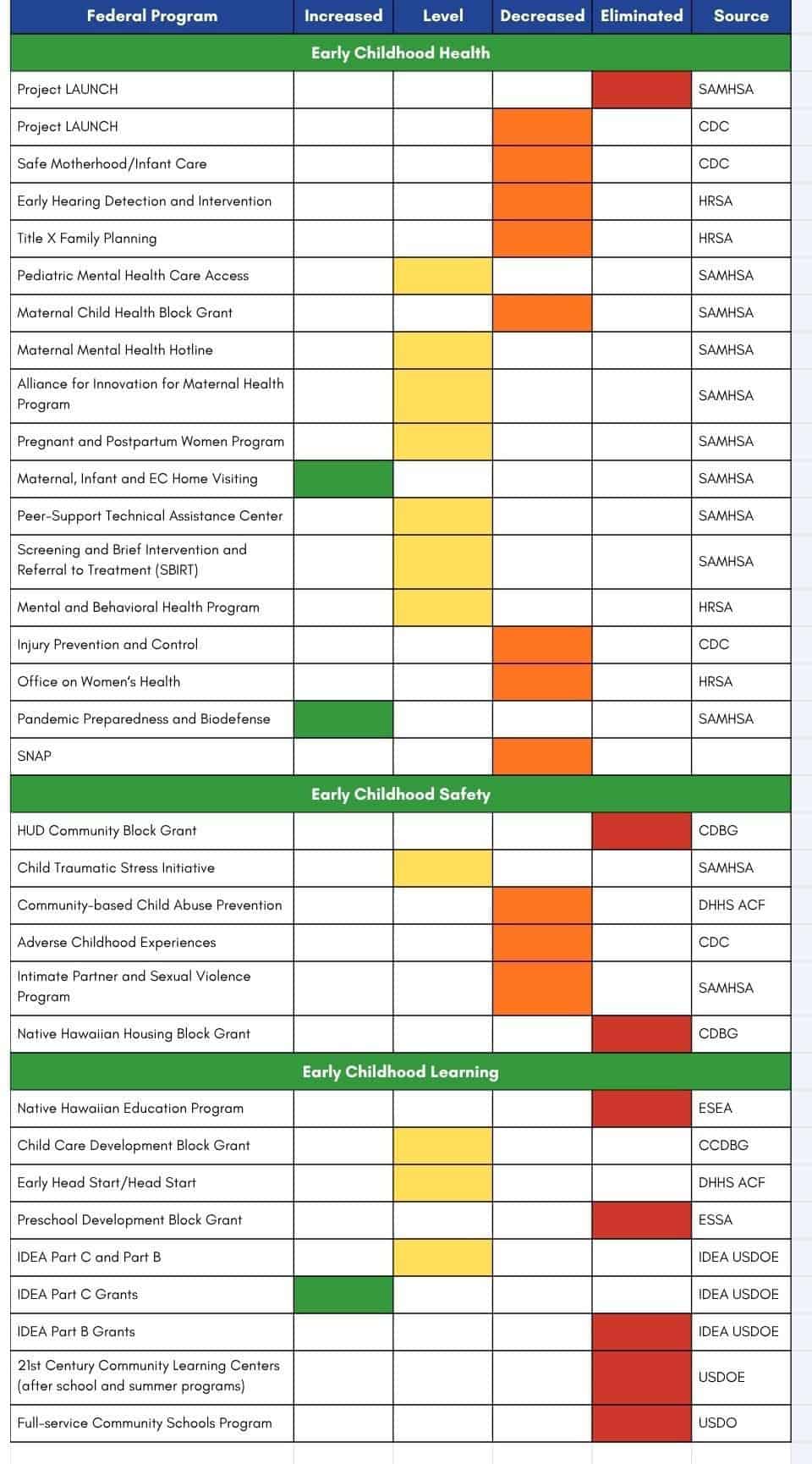
As reflected in the chart below, the proposal presents a mixed landscape. Several cornerstone early childhood programs remain level funded, including Head Start, child care subsidies, and IDEA programs that support children with developmental needs. These programs form the foundation of early learning and early intervention systems that families rely on.
At the same time, the proposal includes both reductions and the elimination of several programs that support maternal and child health, family stability, and community-based prevention efforts. Programs proposed for elimination include Project LAUNCH, the Preschool Development Block Grant, and the Native Hawaiian Education Program. These programs play a critical role in supporting young keiki and families through early learning, mental health services, and community-based care.
As with any federal budget proposal, the full implications will take time to assess. Early childhood systems are deeply interconnected, and shifts in funding can have cascading effects across the services that families depend on. Commit to Keiki will continue to closely monitor these developments and share updates as more information becomes available.